
ACN Advance: Provider Newsletter
April 2020
Thank you for your heroic efforts during this incredibly challenging time. As our community and country navigates the COVID-19 pandemic, Arizona Care Network continues to monitor local and national public health and payer guidelines so we can help support your patient care. Your physician-led Board of Managers is scheduled to meet virtually this week.
Please watch for further communication from ACN as information develops. In the meantime, please share any questions, feedback or ideas we should explore further with your Clinical Performance Consultant or by email at practicetransformation@azcarenetwork.org.

Conley Cervantes Named CEO
Conley Cervantes accepted the role of Chief Executive Officer with Arizona Care Network in March 2020 and joins ACN following two years as a member of the ACN joint venture board.
With more than 25 years of experience, Conley is passionate about helping providers improve patient care and succeed in the evolving healthcare market. For the last 10 years, Conley has led value-based program strategy and operations for Tenet Healthcare, including its Medicare ACOs and clinically integrated networks across 12 states, serving nearly 500,000 covered lives.
Conley’s experience includes negotiating on behalf of hospitals, outpatient centers and employed physicians with leading national and regional payers. Conley has served on numerous industry leadership boards, including the Federation of American Hospitals and the Texas Hospital Association. She is also an advocacy leader for organizations that support people living with autism spectrum disorder.
Both Conley and the Board also expressed gratitude to Todd Ricotta, who served as interim CEO in addition to his regular role as Executive Director, Provider Network and Government Relations. Todd will continue to serve in the latter role as he works to deliver value to our physician-driven network.

2019 Survey Results Highlight Benefits of Participation
The results are in.
Thank you to everyone who participated in the 2019 Provider Satisfaction Survey last fall.
Among the highlights:
- 80 percent of respondents believe ACN’s performance on its mission was “good” or “excellent,” reported consistently across primary care providers and specialists.
- 77 percent of respondents said they “agreed” or “strongly agreed” that they try to refer patients to other ACN-affiliated providers.
- The three highest-rated ACN services were the Provider Rewards Program (PRP), secure provider portal, and Care Coordination team.
- Leading motivations to join ACN included partnering with ACN to improve patient care, access to exclusive payer contracts, and promoting their practice to attract patients.
As we continue seeking ways to improve your physician-led network, a handful of changes have already been implemented for 2020, including:
- Substantial improvements to the PRP metrics
- In-person delivery of quarterly PRP redemption
- Removed all requirements for manual data entries in Athena
- Expanded ways to identify ACN patients at the point of care
- Adopted a provider-led Post-Acute Care Committee
- A new Spanish language version of the Arizona Care Network website
Stay tuned for more opportunities to share your feedback and experiences, notably during Regional Provider Meetings May 6 (Central/West Valley) and May 13 (East Valley).
Find more information throughout this newsletter.

Provider Spotlight: Betty Hinderks Davis, MD
Betty Hinderks Davis, MD, is an ACN Specialist Advisory Council member, board-certified dermatologist, and certified MOHS surgeon who has practiced dermatology in the Valley since 2005. She currently practices at Regency Dermatology in Phoenix and Surprise.
Dr. Davis graduated as an Honors Scholar from the University of Missouri-Columbia (UMC) in biochemistry and completed her medical school training and residency at UMC. She completed her surgical fellowship in Alabama, where she received the American College of Mohs Surgery (ACMS) Theodore Tromovich Award for periorbital tumor research in 2004, the highest national fellow award presented by ACMS. In 2017, she received the Outstanding Young Physician award for distinguished contributions to dermatology.
What led you to join ACN?
I really believe in population health management and preventive care. Every specialty is different in contributing to accountable care, but with dermatology we can do a lot to reduce risks of skin cancer in coordination with oncology and plastic surgeons. We must work together to keep things in network and decrease the cost of health care. It makes our patients healthier.
What led you to join the Specialist Advisory Council?
I like to stay involved and influence a lot of different providers. I’ve found that some are updated on so many things as far as healthcare, safety, the network, peer review. I feel like I have a good understanding and congruent thoughts on practicing medicine. I’m fiscally sensitive which I believe helps a lot — I grocery shop and practice medicine that way.
What are benefits you’ve found through being a part of ACN?
One of the biggest benefits is reduced costs, but also work with providers. A lot of us have other ACN providers on speed dial and can get patients in. Being able to work with primary care physicians is amazing. Some of them go overboard to keep referrals in network and keep costs low, and some don’t. I truly believe in what I call the “2-minute consult,” a provider needs help with a patient in the room, or can take of it but aren’t exactly sure what’s next, and if I can talk to a doctor we can have a plan in place in two minutes, and that saves on costs of care. I can go over how to treat things that are common for PCPs.
Referrals are a major business component for specialists. Is there anything you’d like PCPs to know that can improve alignment and care coordination with specialists?
Set up a system and share notes so everyone else knows your protocol and process. It needs to be short and quick, not 20 clicks. If I’m not on a plane or must be somewhere, I’ll see patients. Be available and willing to help a few extra patients. Get your administrative staff and assistants trained on these processes. Whether it’s push-a-button or a quick reply, it’s something to take work off the PCP.
Any advice for small practices or solo providers who are involved in many aspects of their business?
It’s not easy. Be realistic, and do the things you love the most, and delegate the rest to someone who’s trustworthy so they’re done efficiently.
What advice would you offer to a provider or specialist who’s new to ACN or wants to improve their practice through alignment?
Physicians want to feel connected and forge their own connections. Keeping people connected to the network who are nearby and around your neighborhoods. Medicine is tough right now; it’s daunting there’s so much information and that’s tough to deal with on the fly. I try to pat on the back those who’ve done the same for me, who I know are good and have been good, so it becomes a symbiotic relationship. One of the great things is we can provider coordinated care together, it’s the best care we can offer. Keeping that in front of us and having it be the beacon is why most of us got into healthcare.

Summary Guidelines of Global Initiative for Chronic Obstructive Lung Disease (GOLD)
The GOLD guidelines provide evidence-based recommendations to select a medication individualized based on a patient’s GOLD group. Inhalers should also be evaluated based on their side effects, cost, patient’s preference, and ability to use the inhaler. The appropriate inhaler can improve outcomes and medication adherence.
Here is a list of commonly used COPD medications.2
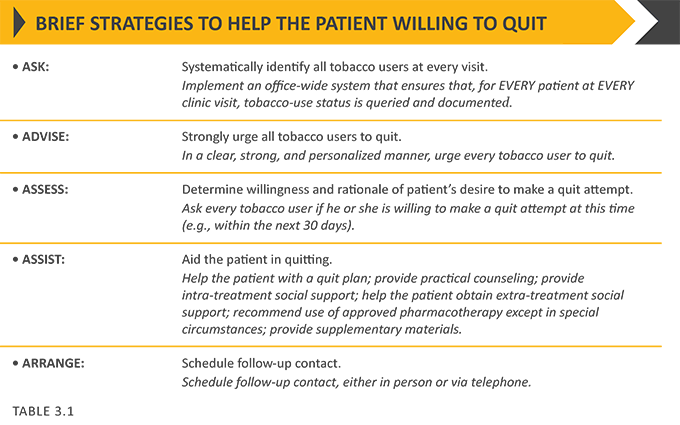
In addition to medications, the 2019 GOLD guidelines recommend smoking cessation and vaccinations as prevention and maintenance therapy. The influenza vaccination can decrease the incidence of respiratory tract infections and death. Pneumococcal vaccination (PPSV23) is recommended in patients less than 65 years to reduce the incidence of community-acquired pneumonia.
PCV13 is recommended in patients aged 65 years and older, administered at least 1 year after PSPV23, to reduce serious invasive pneumococcal disease.3
Smoking cessation3
References:
- Global Initiative for Chronic Obstructive Lung Disease (GOLD) assessment and treatment recommendations for COPD. Sunovion. Retrieved on 3/4/2020 from https://www.sunovionprofile.com/sp/brovana/about/copd-gold-report.html
- Ferguson, G., Make, B. Management of refractory chronic obstructive pulmonary disease. UpToDate, Waltham, MA, 2020
- Global Strategy for the Diagnosis, Management, and Prevention of Chronic Obstructive Pulmonary Disease 2019 Report. Global Initiative for Chronic Obstructive Lung Disease. Retrieved on 10/25/19 at https://goldcopd.org/gold-reports/

ACN Post-Acute Care Committee Improves Network Alignment
In response to your feedback, ACN has formed a physician-led committee focused on issues and processes related to post-acute transitions of care.
Chaired by Dr. Michael Newcomb, ASAP Health Solutions, the Post-Acute Care Committee is the first new committee formed since ACN’s inception in 2013.
Approximately 20 clinical leaders currently hold monthly discussions to review and recommend changes to post-acute care processes, oversight and monitoring, promoting network alliances, best practices, in-network transitions, and share data.
Physicians interested in serving as a member of the committee should email governance@azcarenetwork.org.

News Roundup
- The 2020 Preferred Providers list is available for your practice and office staff. Please contact your Clinical Performance Consultant or email practicetransformation@azcarenetwork.org if your practice hasn’t received laminated copies.
- The ACN website is now available for patients and providers in Spanish. Additionally, the Concierge line (602.406.7226) includes Spanish speakers to help improve member access and communication within our community.
- A recap of news and announcements from the February Board of Managers meeting is available in the Provider Portal.
- Gabrielle Finley-Hazle was announced as the new president and CEO of St. Joseph’s Hospital and Medical Center and St. Joseph’s Westgate Medical Center.
- • Dignity Health and WomenHealth recently conducted a webinar on COVID-19 and its possible impact on patients managing heart disease.

Welcome, New Provider Organizations!
- North Star Wellness (Gilbert)
- Southwest Cardiovascular Associates (Mesa)
- Spectra Eye Institute (Sun City)
- Stripes Urgent Care (Gold Canyon)
You can also view a list of practices and providers no longer participating in ACN.